
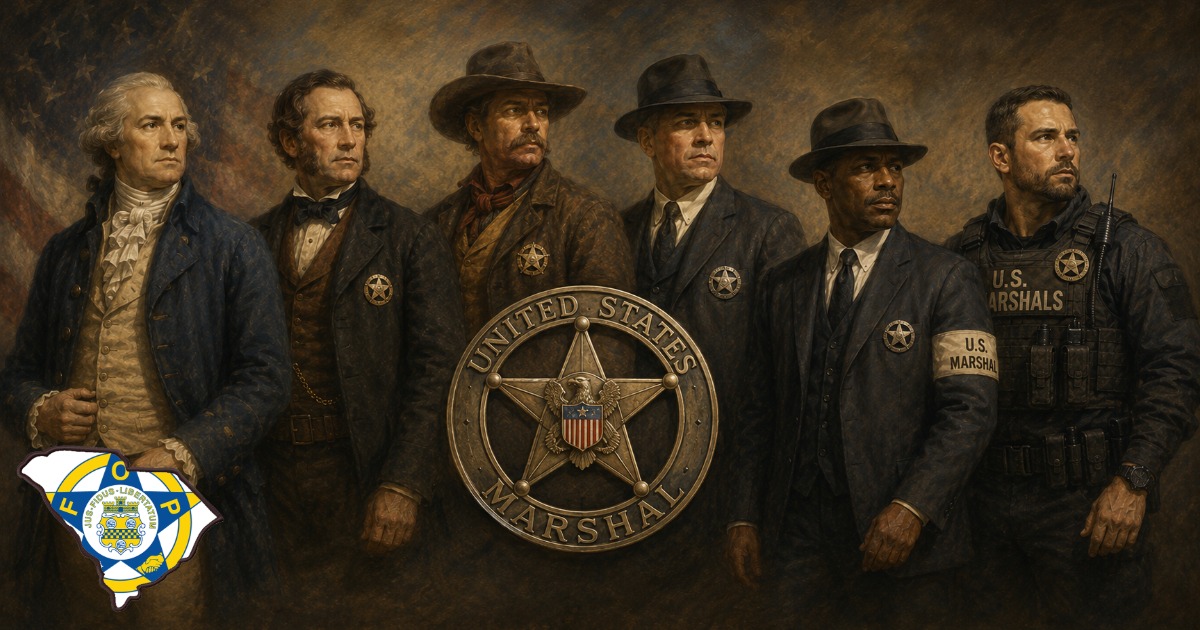
On September 24, 1789, President George Washington signed legislation that helped put the new federal government into operation. The Judiciary Act of 1789 established the structure of the federal court system and provided for officers who could carry out its work across the young nation.

Among them was a new position: the United States Marshal.
The Act provided for a marshal in each federal judicial district. Marshals attended the federal courts, executed lawful federal process within their districts, and could appoint deputies to assist them. The position placed law enforcement responsibilities alongside the federal courts from the beginning of the nation’s new system of justice.
Washington soon appointed the first U.S. Marshals. The office created in 1789 would endure for more than two centuries, developing from a small group of presidential appointees and their deputies into the modern U.S. Marshals Service.
South Carolina From the Beginning
South Carolina was part of that history from the day the Judiciary Act became law.
The Act established South Carolina as a federal judicial district and directed that its district court be held in Charleston. It also joined South Carolina and Georgia in the Southern Circuit, one of three federal judicial circuits initially created by Congress.

The marshal assigned to the district was therefore part of the original federal judicial structure established in South Carolina.
The responsibilities of those early marshals could extend well beyond duties now commonly associated with federal law enforcement. The federal government was still developing, and marshals were among the officials available to carry out its work across geographically large districts.
One of their earliest assignments demonstrates just how broad that work could become.
Counting a Growing Nation
When the United States conducted its first census in 1790, Congress placed responsibility for the count with the U.S. Marshals in the federal judicial districts.
Marshals appointed assistants who traveled through their districts collecting information household by household. The task was significant in a country where transportation and communication were limited, and much of the population was widely dispersed.
That responsibility continued for generations. U.S. Marshals and their assistants conducted the nation’s censuses from 1790 through 1870. Beginning with the 1880 Census, specially hired enumerators took over the work.
By then, the country the marshals served had changed dramatically, and their law enforcement responsibilities had grown with it.
Carrying the Badge West
As the United States expanded westward, deputy U.S. marshals became some of the most recognizable federal law enforcement officers on the American frontier.
Their work took them across large jurisdictions, including territories where distances were substantial, and law enforcement resources could be limited. They pursued fugitives, made arrests, served federal process, transported prisoners, and supported the operation of federal courts.

Among the deputies who served during this period was Bass Reeves.
Reeves became a Deputy U.S. Marshal in 1875 and served for more than three decades in the Western District of Arkansas and Indian Territory. The U.S. Marshals Service credits him with arresting more than 3,000 felons during his career. He became one of the best-known deputies of the frontier era and was among the first known African American Deputy U.S. Marshals west of the Mississippi River.
Reeves’ career is one part of a much larger history. Across the expanding country, generations of marshals and deputies performed the federal law enforcement work required in their districts.
The frontier eventually disappeared. The office of U.S. Marshal did not.
From an Office to a National Service
The federal justice system continued to expand during the 20th century, and the organization supporting the marshals changed with it.
In 1969, the U.S. Marshals Service established a formal headquarters organization to oversee and support district offices across the country. This created the centralized structure associated with the modern agency while preserving an institution whose origins reached back to 1789.
The distinction is an important part of its history. The office of U.S. Marshal began with the Judiciary Act. The modern U.S. Marshals Service developed much later as those district operations became part of a centrally administered federal law enforcement organization.
Despite those organizational changes, the connection to the federal courts remained.
A Mission That Continues
Today, the U.S. Marshals Service remains the enforcement arm of the federal courts, with U.S. Marshals directing operations in 94 federal judicial districts.
Its responsibilities now extend across several major areas of federal law enforcement. Deputy U.S. Marshals apprehend fugitives, protect the federal judiciary, execute federal court orders, maintain custody of and transport federal prisoners, operate the Witness Security Program, and assist with the management and disposition of seized and forfeited assets.
Fugitive investigations also demonstrate how the Marshals Service’s work has developed beyond the boundaries of individual agencies and jurisdictions.
The Service leads regional and local fugitive task forces that bring federal, state, and local law enforcement officers together to locate and apprehend wanted individuals. In the Carolinas, that cooperation includes the Carolinas Regional Fugitive Task Force, with operations in Charleston, Columbia, Florence, Greenville, and Myrtle Beach as well as locations across North Carolina.
The methods, equipment, organization, and scope of the work bear little resemblance to what the first marshals encountered in the 18th century. Yet the institution continues to occupy a place in the federal justice system that can be traced directly to its beginning.
On September 24, 1789, Congress established an office for each federal judicial district and gave its marshals responsibilities necessary to support the new federal courts.
More than two centuries later, U.S. Marshals and their deputies continue that service across a nation far different from the one in which their office began.