
On March 18, 1963, a handwritten letter from a prison cell reshaped the American justice system and permanently altered how criminal cases are built, defended, and prosecuted.
Clarence Earl Gideon was not a lawyer. He was not wealthy or powerful. He was a drifter, accused of breaking into a small pool hall in Panama City, Florida, and stealing loose change from vending machines. When he stood before the judge in 1961, Gideon asked for something simple: an attorney.
The judge refused.
Under Florida law at the time, court-appointed attorneys were guaranteed only in capital cases. Gideon was forced to defend himself. He cross-examined witnesses, challenged evidence, and argued his case as best he could. He was convicted and sentenced to five years in prison.
A Letter From a Prison Cell
From his cell, Gideon refused to accept that outcome.
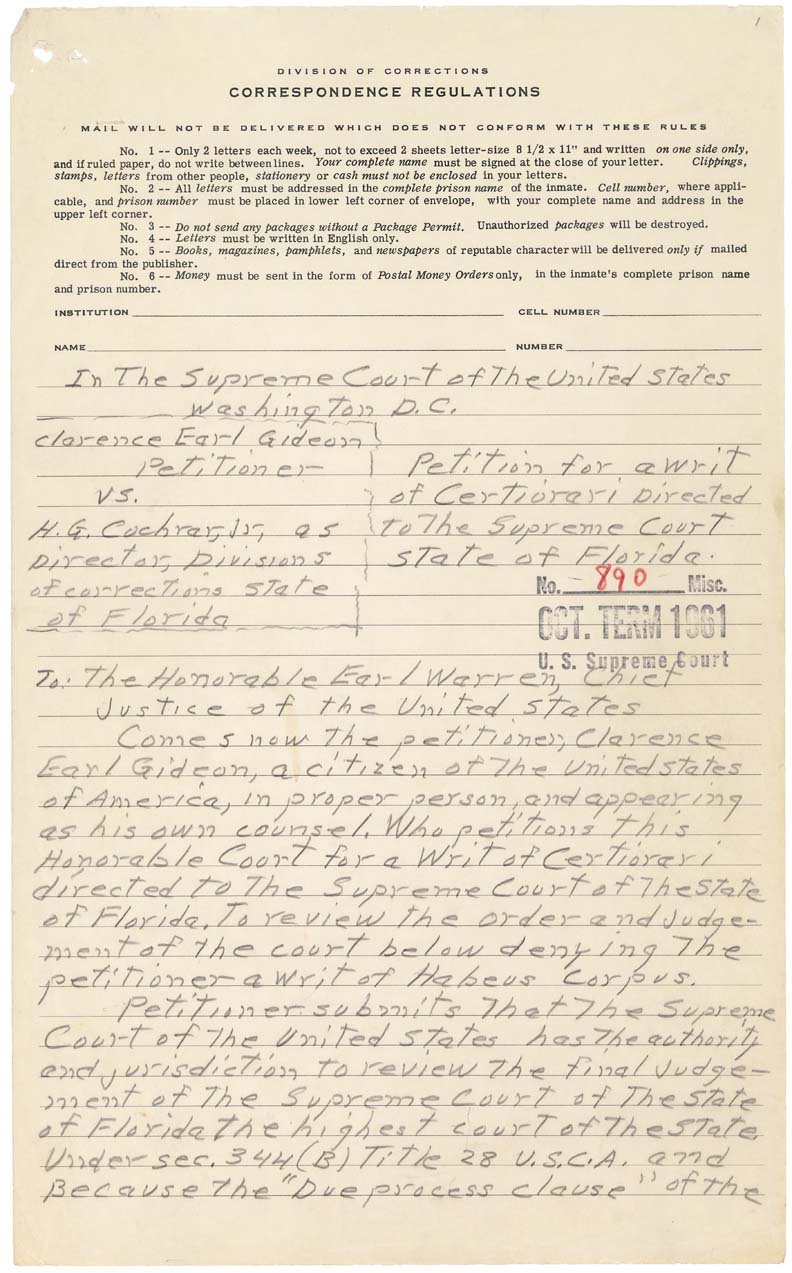
With pencil and paper, he wrote directly to the Supreme Court of the United States, arguing that his constitutional rights had been violated. His petition was handwritten, simple, and direct. Against long odds, the Court agreed to hear his case.
What followed would transform American law enforcement and the criminal justice system.
On March 18, 1963, the Supreme Court issued a unanimous decision in Gideon v. Wainwright, ruling that the Sixth Amendment guarantees the right to counsel in state criminal prosecutions. The decision overturned the Court’s earlier precedent and required states to provide attorneys to defendants who could not afford one in felony cases.
The ruling established a new national standard. No longer would the ability to defend oneself depend on financial means. The courtroom would no longer be a place where the accused stood alone against the full weight of the state.
A Decision That Still Shapes Policing
For law enforcement, the impact was immediate and lasting.
Investigations would now face trained legal scrutiny at every stage. Arrests, searches, and evidence collection would be examined not only by prosecutors and judges, but by defense attorneys whose sole responsibility was to challenge the government’s case. Procedures that may once have gone unquestioned would now be tested in courtrooms across the country.
This strengthened the integrity of investigations.
Officers adapted, as law enforcement has always done. Training evolved. Documentation improved. Warrants became more precise. Reports became more detailed. The profession continued to advance, guided by the principle that cases must withstand examination not just in the moment of arrest, but in the courtroom that follows.
Gideon himself would see the outcome firsthand.
With a court-appointed attorney at his retrial, Gideon faced the same charges, the same evidence, and the same courtroom. This time, the jury returned a different verdict.
Not guilty.
His case became one of the most powerful examples of the American justice system correcting itself. Years later, his story reached a national audience through the book and film Gideon’s Trumpet, which helped bring broader public awareness to the case and its constitutional importance.
The legacy of Gideon v. Wainwright did not end in 1963. Subsequent Supreme Court decisions expanded its reach, ensuring legal representation in cases where imprisonment was possible and clarifying when the right to counsel begins. Together, these rulings reinforced the principle that justice requires both enforcement and fairness.
For modern law enforcement officers, the influence of Gideon is present in every criminal case. Every arrest report, every search warrant, and every courtroom testimony exists within a system shaped by that decision. It serves as a reminder that policing is inseparable from the constitutional framework it protects.
March 18, 1963 stands as a defining moment not because it limited law enforcement, but because it strengthened the legitimacy of the justice system itself. It affirmed that public safety and constitutional rights move forward together, reinforcing public trust and ensuring that the rule of law endures.
One prisoner, one letter, and one decision changed American justice forever.