
On February 24, 1914, the United States Supreme Court issued a ruling that permanently altered the relationship between law enforcement authority and constitutional limits.
The case was Weeks v. United States, and its impact reached far beyond the man whose name it bears. With a single decision, the Court established a principle that continues to shape how officers investigate crimes, obtain evidence, and uphold the rule of law.
At the turn of the twentieth century, federal law enforcement was still finding its footing. Agencies were smaller. Oversight was looser. The boundaries of search and seizure were often tested in the name of enforcement, with few clear consequences when lines were crossed.
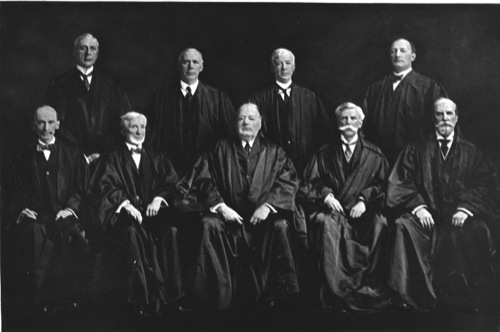
That uncertainty came to a head in the Weeks case.
Fremont Weeks was suspected of using the mail for illegal gambling. While he was away from his home, federal officers entered without a warrant and seized papers and personal items. They later returned for additional materials, again without judicial authorization. The evidence obtained was used to convict him.
Weeks challenged that conviction, arguing that the searches violated the Fourth Amendment’s protection against unreasonable searches and seizures.
The Supreme Court agreed.
In its decision, the Court ruled that evidence obtained by federal officers in violation of the Fourth Amendment could not be used in federal court. This principle became known as the exclusionary rule, and it marked a decisive shift in American law enforcement practice.
For the first time, the Court made clear that constitutional protections were not abstract ideals. They carried consequences.
The ruling sent a powerful message. Law enforcement authority is substantial, but it is not unlimited. The Constitution does not yield to convenience. Evidence gathered unlawfully, no matter how compelling, could not be rewarded with a conviction.
For officers, Weeks v. United States introduced a new level of discipline into investigative work. Warrants mattered. Procedures mattered. Judicial oversight was no longer optional. The decision reinforced the idea that effective policing and constitutional policing are not opposing goals, but inseparable ones.
Over time, the principles established in Weeks became foundational. While the ruling initially applied only to federal officers, it laid the groundwork for later decisions that would extend similar standards to state and local law enforcement. Cases like Mapp v. Ohio would build directly on this precedent decades later.
The legacy of Weeks is not about limiting law enforcement. It is about strengthening legitimacy.
By requiring adherence to constitutional standards, the Court reinforced public confidence in the justice system. Law enforcement investigations gained credibility not only because crimes were solved, but because they were solved the right way. The exclusionary rule became a safeguard, ensuring that justice did not come at the expense of rights.
For modern officers, the influence of Weeks v. United States is constant, even if unseen. Search warrants, probable cause affidavits, suppression hearings, and courtroom testimony all trace their lineage back to this decision. Training academies teach it. Supervisors enforce it. Courts rely on it.
The case also underscored a broader truth about policing in a constitutional republic. Authority flows from the law, not around it. The badge carries power precisely because it is bound by rules that protect everyone.
February 24, 1914 stands as a pivotal moment in law enforcement history because it defined a standard that continues to guide the profession. It affirmed that upholding the Constitution is not separate from public safety, but central to it.
More than a century later, Weeks v. United States remains a reminder that the strength of American law enforcement lies not only in enforcement, but in restraint, judgment, and respect for the rights it is sworn to protect.