“Ridgeland, Ridgeland R-21.”
Those were the first urgent words that carried across the radio on the night of November 20, 1992. Seconds later, Trooper First Class Mark Hunter Coates’ voice rose in panic as he fought for his life on the shoulder of Interstate 95. The dispatcher heard the strain, the fear, and the determination of an officer trying to survive an encounter that had turned violent without warning. Every Trooper who has listened to that recording has felt the impact of those final moments. It is a call no one forgets.
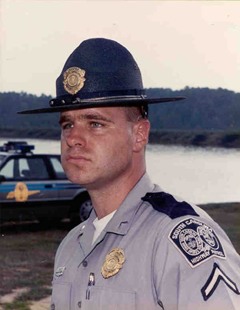
What happened that night has been studied in classrooms, briefing rooms, and academies across the country for more than three decades. But before that night became a training video, it was the final chapter in the life of a man who had already lived a life of service.
Mark Coates grew up in Irmo, South Carolina, where he played football and graduated from Irmo High School in 1980. He joined the United States Marine Corps, earning the title Marine before returning home and serving as an EMT and paramedic in Lexington County. He understood emergencies long before he put on a Highway Patrol uniform. He knew what fear looked like. He knew what urgency felt like. He knew what it meant to stand between danger and the people who needed help. He carried that understanding with him when he joined the South Carolina Highway Patrol in 1987.
Trooper Coates spent his first years in Greenwood County before transferring to Newberry County. By 1991, his skill and drive earned him a spot on the newly created Aggressive Criminal Enforcement Team. In just over a year, he made dozens of drug arrests, recovered stolen vehicles, captured fugitives, and helped pull significant amounts of drugs and cash off South Carolina roads. His instincts were sharp. His work ethic was unmatched. When Troopers tell stories about him today, they talk about how much he loved the job and how committed he was to getting dangerous offenders off the highway.
On November 20, 1992, those instincts proved correct again.
A little after 8 p.m., five years to the day after he graduated Patrol School, Trooper Coates stopped a 1967 Mustang on I-95 near mile marker 7. The driver, thirty-two-year-old Richard Blackburn, appeared calm as Trooper Coates prepared a warning. But when asked to remove his hand from his pocket, Blackburn attacked without hesitation. The dash camera captured the sudden shift from routine to life-or-death struggle.
Blackburn pulled a .22 magnum revolver and fired. The first rounds struck Trooper Coates’ vest. He returned fire with his issued .357, hitting Blackburn repeatedly while trying to create distance and call for help. “Ridgeland, Ridgeland R-21,” he shouted as he moved in front of the Mustang, trying to protect himself and direct responding officers to his location.
Then came the shot that found the gap in his vest. It entered through his left arm and traveled into his chest. Even as he fell, he kept calling on the radio until he could no longer speak.
Two truck drivers stopped to help. Fellow Troopers arrived within minutes. He was airlifted to Savannah Memorial Medical Center, but his injuries were not survivable.
Trooper Mark Coates was 30 years old.
In the days that followed, his family, friends, and colleagues buried him in Chapin Baptist Church Cemetery. A horse-drawn caisson carried him to his resting place. South Carolina lost a son, a Marine, a paramedic, a Trooper, a husband, and a father.
The courtroom chapter ended nearly a year later, when Blackburn was convicted of murder and sentenced to life in prison. He died behind bars in 2024.
But Trooper Coates’ legacy did not end there.
The dash-camera video of his final moments became one of the most influential training tools ever used in American law enforcement. It has been shown to thousands of officers nationwide, shaping defensive tactics, radio procedures, and survival training. Countless officers have walked away from that video understanding the importance of awareness, persistence, and the will to fight for life. Many have said privately that the lessons they learned from that footage helped them survive.
His family turned their pain into purpose, becoming deeply involved in Concerns of Police Survivors and the SC Law Enforcement Assistance Program. Their compassion has helped hundreds of officers and families navigate the emotional aftermath of critical incidents.
A section of Interstate 95 now carries his name. His name is embossed on the South Carolina Law Enforcement Memorial at the Statehouse. And every year, Troopers still tell stories about him—some solemn, some funny, all full of respect.
Trooper First Class Mark Hunter Coates’ life reminds us that every traffic stop carries unknown risks, every encounter can turn in an instant, and every officer on the road faces dangers most people never see. His service, his courage, and his final call continue to teach, protect, and inspire the men and women who follow in his footsteps.